Execution-grounded CAD generation
CAD-VIGA
Agentic Vision-Guided Refinement for Parametric CAD Generation
A coding agent that does not merely imagine geometry. It plans, writes executable CadQuery, renders the result, checks semantic evidence, and revises until the model passes.
MCPCadQuerySemantic PARTSVision feedback
The research question
Can a general coding agent become a useful CAD agent when execution is part of its reasoning loop?
CAD-VIGA surrounds a multimodal coding agent with planning, kernel execution, semantic rendering, geometric evidence, and a verifier protocol—without training a new CAD-specific model.
Executable programs, not decorative meshes
The primary artifact is editable CadQuery code. Every accepted result must run in a CAD kernel and preserve a meaningful construction procedure.
result = build() → execute → render → verify
Semantic part identity
A required PARTS manifest assigns stable names to logical components, making visual feedback precise and traceable.
Validity is only a sanity gate
A watertight mesh can still contain the wrong opening, a floating support, a damaged silhouette, or an implausible interface.
Separate reliability from fidelity
The paper reports pipeline completion, geometric overlap, and semantic correctness separately. That distinction prevents orchestration failures from being mistaken for reconstruction failures.
Demo video
The video is unavailable. Check that the Google Drive file is shared with anyone who has the link.
Interactive evidence
Inspect the aircraft in three dimensions.
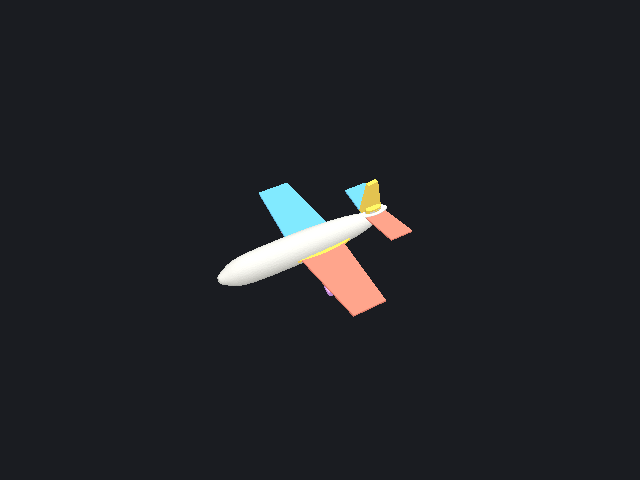
The aircraft above is fetched directly from model.stl, parsed in the browser, and rendered as live WebGL geometry—not as a pre-rendered spin. Drag, pinch, zoom, auto-rotate, or switch to wireframe to inspect the actual uploaded mesh.
Aircraft assembly
This is the uploaded 14.3 MB aircraft STL rendered at runtime. The viewer streams and parses 286,299 triangles, reorients the CAD Z-up export, and fits the real mesh to the camera.
Runtime artifactOne source model, rendered live from the repository.
assets/models/aircraft/model.stl is fetched by the browser. The original CadQuery program and six backend renders are packaged beside it for provenance and comparison.
Interactive system map
Follow evidence through the CAD-VIGA pipeline.
Select a stage or individual tool to see its responsibility, evidence, and outputs. The animated trace follows the main execution path; a blocked final gate returns the agent to a targeted correction round.
01
InputsSpecification
02
Coding agentGenerator + verifier
03
Local MCP serverState + orchestration
04
CAD executionKernel + evidence
01
Input specification
Prompt
The prompt supplies object identity, desired dimensions, functional intent, and any constraints that are not reliably inferable from pixels.
intentdimensionsconstraints
Semantic quality gates
01
02
03
04
The verifier checks the engineering story, not just the silhouette.
CAD-VIGA rejects unresolved evidence even when the mesh executes. High-risk interfaces receive adaptive close-up renders, and functional openings must have modeled depth rather than a visual trick.
Fitted attachments
Roots, seats, sockets, fairings, and transitions must visibly connect.
Continuous load paths
Pylons, brackets, rails, struts, mounts, and supports must bridge the parts they connect.
Functional depth
Recesses, bores, channels, ducts, and openings are verified as real geometry.
Reference-critical curvature
Rounded, domed, tapered, or softly blended contours cannot collapse into blocky approximations.
Controlled benchmark · seed 42
CAD-VIGA made reliability the decisive end-to-end result.
We evaluated 15 difficulty-balanced BenchCAD Vision2Code samples—five easy, five medium, and five hard—with three attempts per method. CAD-VIGA completed all 45 attempts; the one-shot baseline completed 17 of 45.
CAD-VIGA
45 / 45
100% executable completion
One-shot baseline
17 / 45
37.8% executable completion
Reliability gain
+62.2 pp
28 baseline attempts failed before producing an evaluable CAD result.
End-to-end meansFailures = 0
The fairest pipeline-level view: every failed attempt contributes zero.
Voxel IoU0.3800CAD-VIGA
2.44×
Voxel IoU0.1559Baseline
Composite0.5073CAD-VIGA
2.56×
Composite0.1978Baseline
Successful-run meansFailures excluded
Among attempts that executed, geometric fidelity was similar and the baseline means were slightly higher.
Voxel IoU0.3800CAD-VIGA · n=45
≈
Voxel IoU0.4127Baseline · n=17
Composite0.5073CAD-VIGA · n=45
≈
Composite0.5236Baseline · n=17
Completion by difficulty15 attempts per tier
Easy15/15 vs 8/15
CAD-VIGA 100% · baseline 53.3%
Medium15/15 vs 6/15
CAD-VIGA 100% · baseline 40.0%
Hard15/15 vs 3/15
CAD-VIGA 100% · baseline 20.0%
CAD-VIGAone-shot baseline
Statistical reading
Reliability improved; successful-run fidelity did not show a significant difference.
Welch tests over successful attempts found no statistically significant difference for Voxel IoU (p = 0.690) or composite score (p = 0.784). CAD-VIGA was also slower: 447 s per attempt on average versus 61 s for the baseline. The result supports execution-grounded reliability, not a claim of universally better geometry.
All 15 samples
Explore completion and quality sample by sample.
Means are calculated across successful attempts. “No result” means all three baseline attempts failed.
Loading benchmark records…
Latest benchmark evidence
Representative outputs from the new 45-attempt CAD-VIGA run.
Each card uses the uploaded run’s reference image and links to the actual generated STEP program artifact. The headline metric is the three-attempt sample mean; the attempt strip shows run-to-run variation.
Hard
Ball knob
Three successful generations, including two near-perfect attempts. The sample mean remains high despite variation in attempt two.
Mean Voxel IoU0.8857Mean composite0.9308
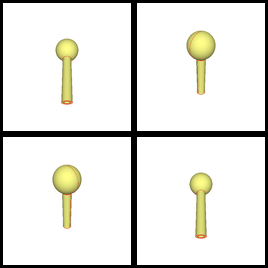
Composite by attempt
A10.9851
A20.8120
A30.9953
Best artifact: attempt 3 · IoU 0.9938Hard
Hex-key organizer
All three attempts executed. The third attempt reached a perfect benchmark score, while the sample mean captures the weaker first attempt too.
Mean Voxel IoU0.8341Mean composite0.8770
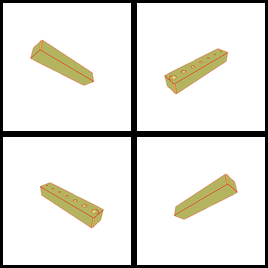
Composite by attempt
A10.7438
A20.8871
A31.0000
Best artifact: attempt 3 · IoU 1.0000Easy
Tee nut
A stable three-attempt result: all programs executed and the score stayed within a relatively narrow band.
Mean Voxel IoU0.6194Mean composite0.6694
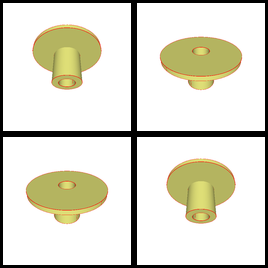
Composite by attempt
A10.6697
A20.6990
A30.6394
Best artifact: attempt 2 · IoU 0.6590
Honest interpretation
What the updated study establishes—and what remains open.
On this 15-sample, three-attempt benchmark, CAD-VIGA eliminated execution failures: 45 of 45 attempts completed, compared with 17 of 45 for one-shot generation. That reliability produced much stronger zero-filled end-to-end scores.
Reliability is not the same as geometric superiority.
Among successful attempts, the two methods had similar means and neither Welch comparison was statistically significant. CAD-VIGA’s strongest claim here is robust completion under tool feedback.
Small benchmark
Fifteen samples and one random seed are evidence, not a definitive leaderboard.
Uneven fidelity
The hard tier contains both near-perfect results and severe semantic mismatches.
Higher compute cost
Iterative planning, rendering, and verification took about 7.4× longer per attempt.
Next experiment
More seeds, larger samples, ablations, and paired human review are needed to isolate which feedback tools improve geometry.
Run CAD-VIGA
Connect the MCP agent to the CAD backend.
The local client stays lightweight. CadQuery execution, rendering, metrics, and heavier dependencies live on the backend.
Install the MCP server
pip install git+https://github.com/Mousatat/CAD-Agent-capastone.git@cadviga-mcpAdd it to Claude Code
claude mcp add cad-viga --command "cad-viga" --env CAD_API_URL=http://127.0.0.1:9000Start the backend
git clone --branch cadviga-viewer --single-branch https://github.com/Mousatat/CAD-Agent-capastone.git
cd CAD-Agent-capastone && bash START_SERVER.shCitation
Cite CAD-VIGA.
The downloadable paper documents the earlier preliminary run; this website also reports the newer controlled baseline comparison from the uploaded benchmark archive.
@misc{abdullin2026cadviga,
  title  = {CAD-VIGA: Agentic Vision-Guided Refinement
            for Parametric CAD Generation},
  author = {Abdullin, G. and Blinov, A. and Narimov, A.
            and Gilmetdinov, R. and Mousatat, M.},
  year   = {2026},
  note   = {Project paper, Innopolis University}
}